


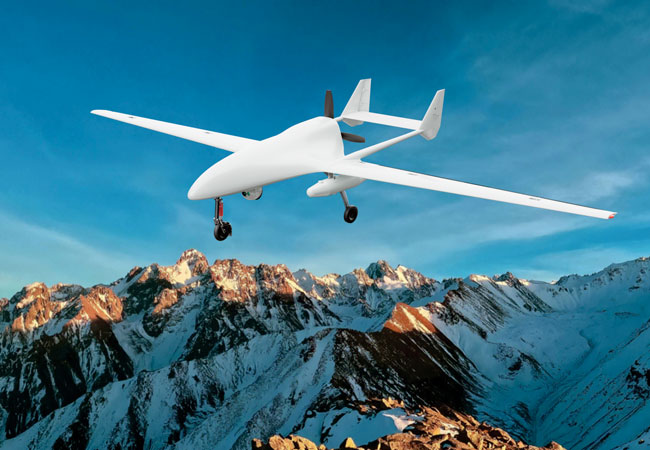
Range - 120+ km
Endurance - up to 10 h
Flight speed - 100-125 km/h
Maximum ayload weight - 80 kg
Altitude - up to 4000 m
Technical specifications
| Power unit | internal combustion engine |
| Wingspan, m | 9,24 |
Maximum range of use without loss of radio communication, km – when providing direct radio communication between the GCS and the UAV |
up to 120 |
| Maximum ferry range, km (takeoff from one airfield, flight and landing at another airfield) | up to 1000* |
| Ceiling, km | up to 4 |
| Cruising speed, km/h | 100–125 |
| Endurance, h | up to 10 at cruising speed and flight altitude of 1000 m |
| Maximum takeoff weight, kg | 390 |
| Maximum payload weight (including optical-electronic system), kg | up to 80** |
| Ground control station type | portable or mobile (based on a minibus, all-terrain vehicle) |
| Flight and navigation system | GPS, GLONASS and ACS with the ability to fly UAVs without satellite communications |
| Method of take-off and landing | like an airplane from a runway, with the possibility of using a braking landing system; emergency landing - parachute |
*with additional external fuel tanks
**with increasing payload weight, the amount of fuel decreases and the flight duration is reduced
The composition and characteristics are specified at the stage of concluding the contract.
Composition of the system:
- Unmanned aerial vehicle
- Ground control station for:
- control of launch and flight of UAVs;
- receiving, recording, processing, storing, displaying parametric and visual information from UAVs
- Payload set
- Interference-proof data transmission and reception equipment with automatic rotary support device
- Ground flight support facilities
- Repair kit SPTA
- Set of operating documentation
Autonomous simulator for training UAV operators (optional supply)
The autonomous simulator is used for in-depth training of UAV operators (payload operators) in the principles of using the unmanned aerial system, as well as for quality control of UAV operator training without using the system's standard tools. The simulator allows training UAV operators using developed computer 3D models of specific UAVs, which, in terms of their geometric, mass and aerodynamic characteristics, correspond as much as possible to existing UAVs.